In my post on how much audio bandwidth was really required, I posited that there was not sufficient benefit to justify the impacts of pushing the low end frequency response of our tube amps down to 20Hz. As part of that post I included the following statement.
“In order to pass really low frequencies the primary inductance of the output transformer must be rather large. Now the difference in frequency between 20Hz and 40Hz is a full octave. This means that a transformer designed to pass 20Hz at the same level as one designed to pass 40Hz must have a primary inductance which is twice as large. This equates to a much larger and more expensive coil and also introduces complexities at the upper end due to interwinding capacitances. This drives one to rather expensive solutions.”
Now there are those that may suggest that, given the overall cost in time and materials to produce a high fidelity amplifier, the additional size and expense in the output transformer is entirely justified. The rhetorical questions which immediately come to mind include “Why not simply spend the additional funds and get the bigger transformer?” and “Isn’t larger primary inductance in an output transformer better?”. Unfortunately, like most things in Engineering, there are tradeoffs involved. So my goal here is to examine those tradeoffs and explore the possibility that those large transformers might be doing more harm than good in your output stage operation.
First I would like to explore why the larger primary impedance of the output transformer supports a lower frequency roll off. Without going through the derivation, the low frequency roll off of a transformer coupled stage (which is what a transformer coupled output stage is) is defined by the following relation:
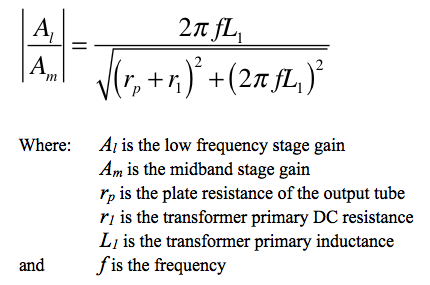
This formula relates the low end frequency response to the midband gain of the output stage. It is a mathematical definition of low end roll off. From this relation it is simple to see that for any given frequency, the larger L1 becomes, the closer to 1 the relation becomes and hence the lower the low frequency rolloff. This is at the heart of why larger transformers produce better low end performance. If one was to only look at this relation, it would drive you to want larger and larger output transformer primaries, in order to drive the low end performance of the amplifier. However, there is something else to consider.
It is important to understand the conditions under which a normal output stage operates. Take for example a simple single ended triode, cathode biased output stage with a transformer load. At zero input voltage, the output tube will be operating at the DC bias point determined by the B+ voltage, the bias resistor, the transformer dc primary resistance, and the plate characteristics of the output tube. Now, if the tube were distortionless (indicating that all harmonic distortion terms were zero) then regardless of the drive level, the bias point would remain at the dc bias point. The issue arrises because the tubes are not distortionless.
Because of the distortion in a tube, there is a shift in bias current driven by the magnitude of the even term harmonic distortions. This change means that when the output tube is being driven hard, the dynamic bias point (and current) can be significantly different than the dc bias point (and current). What this means is that there must be a transition between bias currents when there is a transition between drive levels. So what does all this mean?
Lets look at the example of a rapid transition in volume. In classical music this could be a trumpet blast or the crash of cymbals. In both cases, the level of the music, and hence tube drive and load current, changes suddenly. This sudden change is the crux of the problem. When the current in an inductor suddenly changes, there is an induced voltage in the inductor proportional to the inductance and the rate of current change. The magnitude of this voltage is to oppose the change in current. Normally this is written as:
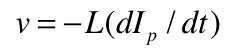
This voltage acts to oppose the B+ voltage and hence limit the plate current in the output stage. Once this happens, the current begins to increase exponentially until the steady state dynamic operating point is reached. In effect, this phenomenon limits the transient dynamic response of the output stage. And because of the relation above, it can be seen that the larger the primary inductance of the output transformer, the slower the transient response will be.
So this is the technical explanation, but what does it mean sonically. Lets return to my example of the trumpet blast. A trumpet blast in classical music is an example of a marcato fortissimo or very strong, marked transition in the music. Such a transition will markedly shift the operating point current from one value to one much higher. This transition cannot occur instantaneously but will take time to occur dependent on the size of the primary inductance. The effect of this phenomenon is one of blunting, or slowing the transition. Additionally, the nonlinear nature of the exponential ramp will increase distortions as the transitions take place. The net effect being that a transition which is intended to be sharp and crisp, becomes muddled and distorted. In some cases, the effect is minor. But in large transitions, the effect can rob the music of important dynamic character.
Sometimes you’ll hear an amplifier described as “light” or “responsive”. This is an amplifier that has good transient response. One that can rapidly change levels without undue lags or distortions. On the other end of the spectrum an amp may be described as “slow”, “dull”, or “muddy”. These are examples of an amplifier which has poor transient response. It is one that sounds fine with music that is melodious, which ebbs and flows easily, but cannot handle the rapid changes that a dynamic score requires. And note that this is not just an issue at low frequencies, the relation above is independent of frequency. Rapid changes in the mid and upper bands are just as affected as the low frequency notes.
Could this be the explanation for why those some of those lower cost transformers seem to get such praise from the DIY community? The Edcor GXSE and XSE transformers seem to get very favorable reviews from some builders in spite of their 40Hz and 70Hz respective low end roll off frequencies. So lets compare several transformers of approximately the same primary impedance. I will start first with some “full bandwidth” 20Hz to 20kHz models. From “One Electron” lets look at the UBT-2 4800Ω unit, from Hammond I’ll choose the 1628SEA and 1642SE 5000Ω units, and from Edcor I’ll look at the CXSE25-8-5K.
Of these transformers, the UBT-2 gets the highest reviews on the web. Reviews of the Hammond and Edcor models are next in line and tend to run neck in neck. So what do we know about these output transformers? Well, here are their primary impedances and inductances:
One Electron UBT-2    4800Ω   29H
Hammond 1628SEA       5000Ω   48H
Hammond 1642SE        5000Ω   53H
Edcor CXSE25-8-5K     5000Ω   50H
This illustrates a possible insight. The highest subjectively rated of these transformers is actually the one with the lowest primary inductance. This is a trend which seems to go against the conventional wisdom. Most believe that larger primary impedance means a better output transformer. However, technically we know that the UBT-2 is going to have almost half the transient response time of the Hammond and Edcor transformers if used in the same amp at the same bias point. This could well be the reason that it tends to beat out the others in subjective listening tests. Now just for illustration, lets throw a 40Hz roll off transformer into the mix; the Edcor GXSE10-8-5K. Here is the same list given above (for perspective) with the new transformer added.
One Electron UBT-2    4800Ω   29H
Hammond 1628SEA       5000Ω   48H
Hammond 1642SE        5000Ω   53H
Edcor CXSE25-8-5K     5000Ω   50H
Edcor GXSE10-6-5K     5000Ω    5H
This is even more illustrative. By giving up those 20Hz on the low end, this transformer has only 1/10 the primary inductance of its brother the CXSE25-8-5K. Now some of this is obviously due to its lower power rating, but it is still a significant reduction. In theory, this little output transformer will have ten times the transient response of the larger units.
So this is my thesis. The reason that the smaller output transformers have such a loyal following among the DIY community is not simply a matter of price. It is a matter of overall performance. If you build an amplifier and forgo the lowest of the low frequencies by using one of these, you will get much better transient performance from your amplifier. And this transient performance adds much more to the music than the frequencies between 20Hz and 40Hz ever could.
Questions or comments? Drop me a note and let me know what you think.