Well, my blog seems to be quickly becoming a list of things to avoid doing. I’ll get back to the more technical stuff soon but in the mean time I have one more blooper to share. I hope there aren’t too many objections.
So I have a new amplifier I just finished which will soon be added to the ever growing list of amplifiers on the web page. But when I was putting it together I managed to destroy a couple of expensive tubes due to a very simple error early on in the design process. Let me explain.
When I start to lay out an amplifier’s internals for point-to-point wiring, I tend to do some planning about where everything is going to go. I don’t always follow it exactly, but it does allow me to virtually prototype my layouts to see if there are crowded sections, or places where distances are too great for a component to bridge. I then use the layout diagram to check things while putting the amp together. And this amplifier was no exception.
When I do this, I make a layout drawing of the underside of the top plate, label all the tube connections, and insert components on the drawing. Here is a small section of the one I made for this amp.
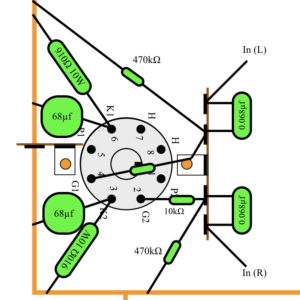
This is the wiring diagram for the large dual triode power stage in the amp. This way I can see where all the components go and where connections are to be made.
So I assembled the amp, checked (and then re-checked) all the connections to be sure they were correct, and performed my initial power on checks. The entire signal/drive stage checked out fine, as did the left power channel. However, the right power channel gave improper voltages and very high plate currents. I then shut off the amp and checked everything again. Again I found no mistakes.
I then made the assumption that, of course, I had gotten a bad tube. These were used tubes and it was very conceivable that I had one with a bad channel. So I replaced the tube with a new one and tried again. And again, bad voltages and high currents were seen in the right power channel. It is possible I got two bad tubes but not very probable. So I began checking my circuit again. This time in great detail and verifying assumptions as I went.
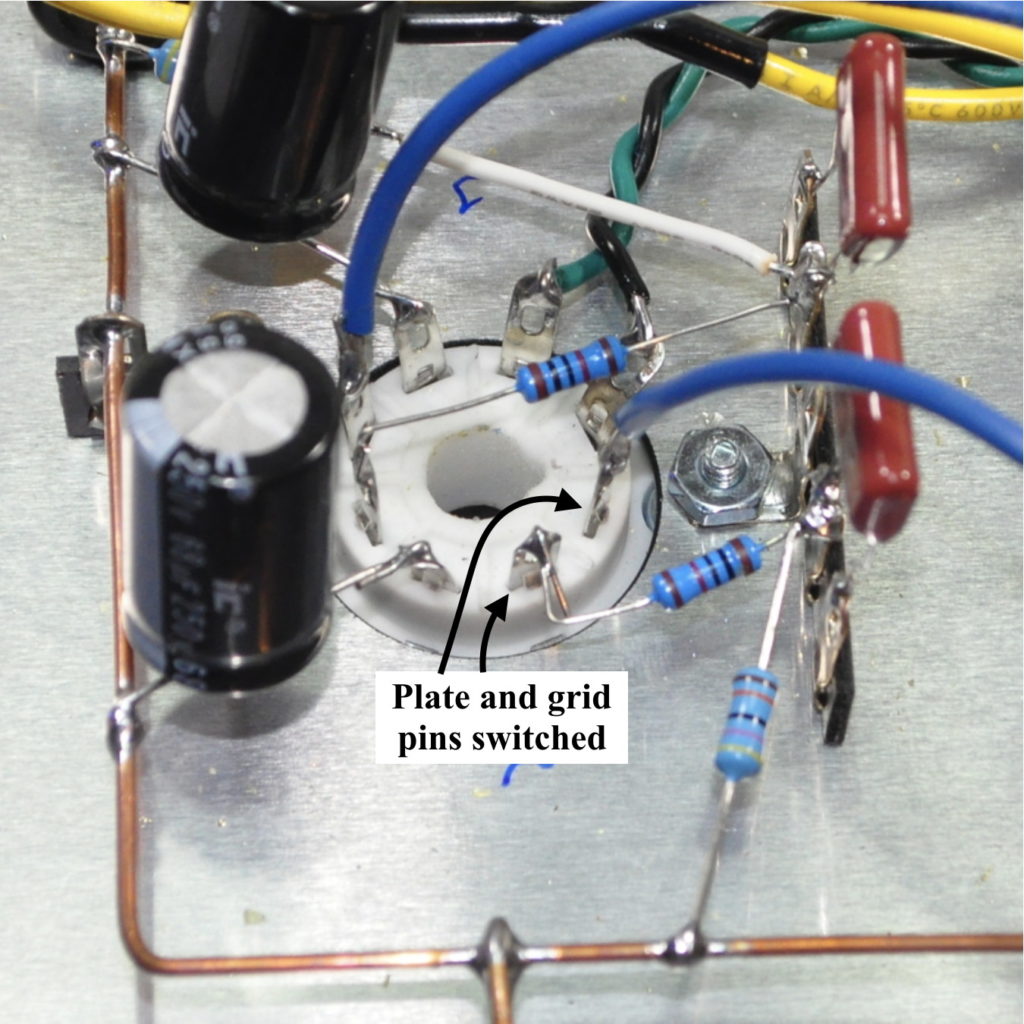
Just by chance, when I started to review the internal layout, I picked up the front page of the power tube data sheet and looked at the pin basing diagram. And that’s when I saw it. The labels on the basing diagram did not match the labels on the layout drawing above. The labels on pins 1 and 2 were reversed from what I had assumed. Here is a picture of the improperly assembled wiring.
So the simple moral to this post is, again, always check your work. Just because you took notes and documented everything, doesn’t necessarily mean that those notes are correct. This is just as true for a thirty year Engineer like myself as it is for someone just starting out. And this mistake cost me about $50 USD in tubes. An expensive, but well learned lesson. I think I’ll be inserting an assumption check into my design process in the future.
Thoughts?