Anyone who has taken a look around this site should soon realize that I really like my low power amplifiers. What this means is that most of my listening is at lower volume levels. Now the only problem with this is that the sensitivity of the human ear to different frequencies is dependent on volume level. So at low volume levels, the ear has relatively poor sensitivity to both low and high frequencies. And the quieter the music gets, the worse the mismatch becomes. Traditionally the answer to this conundrum was the humble “loudness” control.
The typical approach was simple. Using a tap on a normal volume potentiometer, usually between the 40% and 50% shaft rotation point, a tone shaping circuit could be switched in, or permanently wired in, to boost these less sensitive frequencies at lower volumes. The only problem was that some of these controls really helped and some did more harm than good. And trying to discern good circuits from bad is not a simple task.
After poking around on the internet and doing some numerical analysis of various circuits I came to a simple conclusion. Although I could easily analyze and numerically define the characteristics of several different circuits, I could not in any useful way determine what was good or bad about the curves I generated. It was clear that I needed to put my ears to work to answer my questions about using those ubiquitous little “loudness” taps on so may audio taper potentiometers.
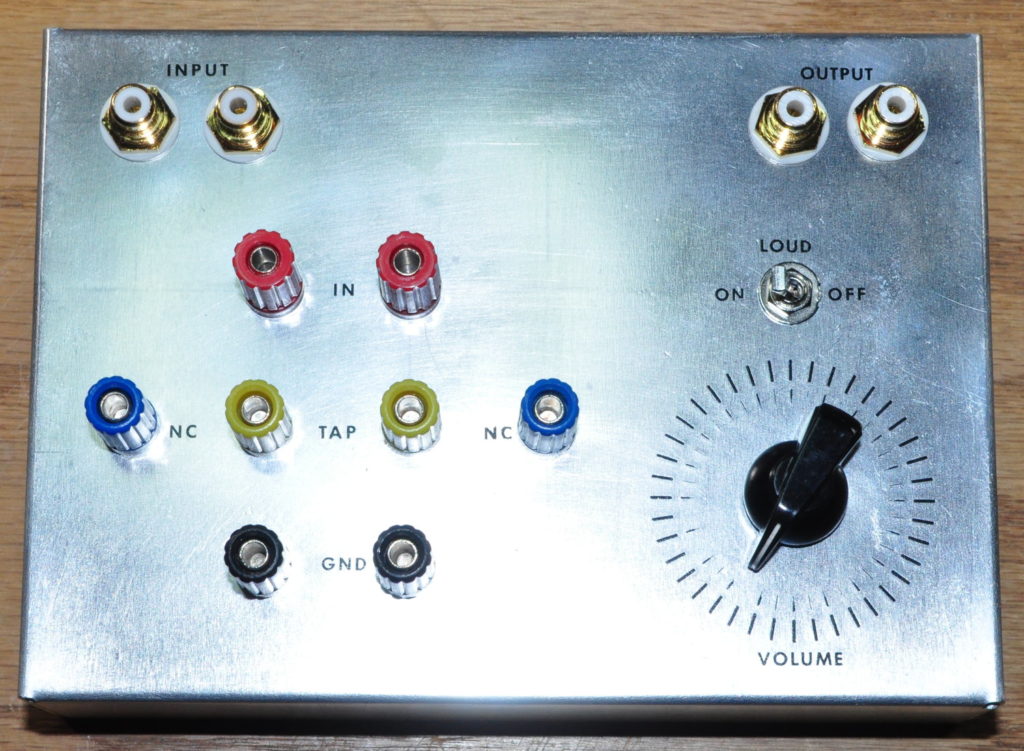
So i decided that I would put together a little volume control that would allow me to perform some simple experiments. It looks like this:
I am just getting down to doing some data collections and some hearing tests. Soon I should have a whole writeup on what I find. Maybe it will help some other people make use of those mysterious little “loudness” taps.