For those that are paying particular attention to my amp builds it will come as no surprise that I think the #44 and #47 (0.9 and 0.5 candela respectively) indicator lamps are a little bright to be used on tube amps. I just think that they tend to overpower the look of the amplifier when the room gets dim. However, as these lamps are ubiquitous, it pays to use them in our builds. So, on the 6DJ8 Headphone amp and the 6EM7 vertical amp I included a small adjustment potentiometer to tame these power indicators. And on the Marblewood amp, I chose a fixed 25Ω 1W resistor to dim the indicator.
However, as I was contemplating a new amplifier design, I was considering using a couple of these lamps to provide a backlight to a chamber holding the tubes. So I wanted to be able to play with different lenses or jewels, and different bulbs. And I wanted to be able to vary the intensity. Clearly I would need something a little more than some alligator clip leads and sockets. My answer was to throw together this little jig.
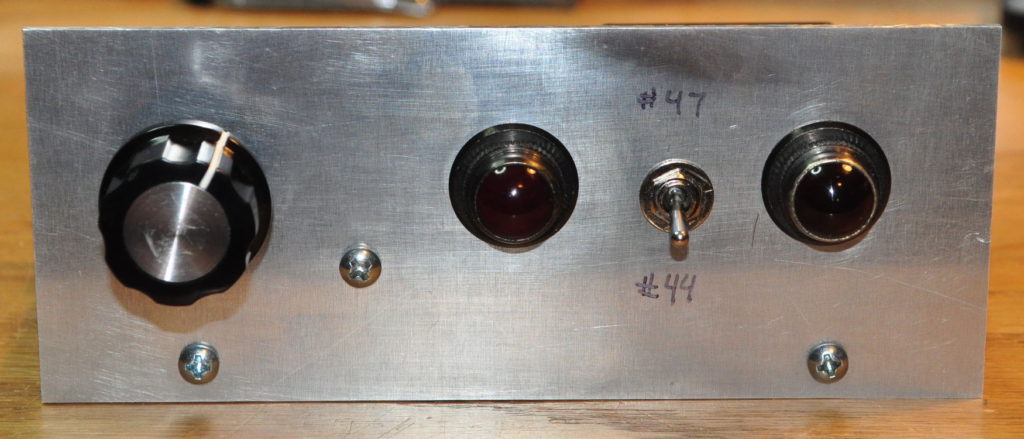
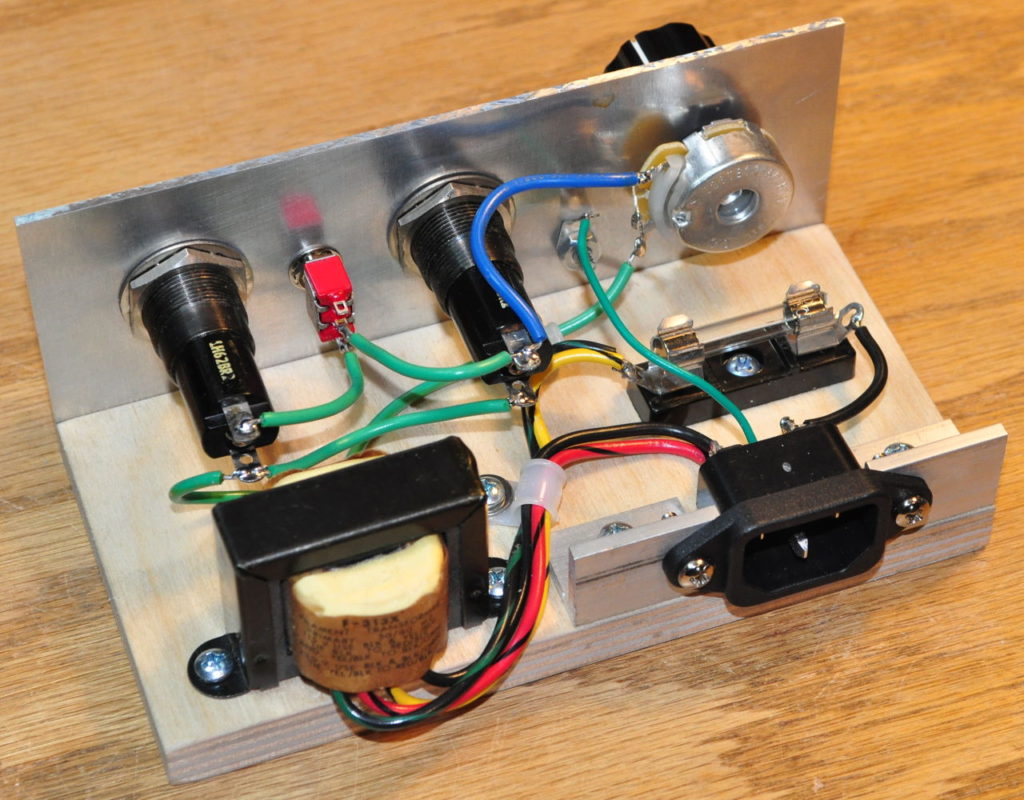
As can be seen this is a fairly simple jig. It’s just a piece of aluminum plate and a small base of baltic birch plywood with parts attached. It contains a couple of indicator panel sockets, a rheostat to vary the intensity of the lamps, a switch that selects one or two sockets, and a minimalist power supply. There isn’t even a dedicated power switch, just plug it in and it’s on. This was built entirely from parts I had on hand.
Some people may question the wisdom of spending the time and money to build something like this. It seems to be fairly single purpose, and these are parts that could have been used in another project. And then there is the cost. However I should mention that the most expensive item here is the 50Ω, 5W rheostat. The panel indicators were bought from a used electronics place for 25¢ a piece, the little filament transformer was $1 from the same place. The other parts are all part of bulk buys for significantly less that $1 each. Overall I think I have about $10 USD into this jig and about 90 minutes of my time.
The real benefit of this device is that it allows me to focus on what I want to do (i.e. investigate various light arrangements) and takes away the tedium and problems associated with the “how” to do it (i.e. the power supply, light sockets, electrical connections, etc.). I really don’t know how often I’ll use it, but it will always be available if I want to check some bulbs or just see what a particular jewel or lens looks like in front of a bulb.
So does anyone else build jigs like this or am I a misfit among the masses?