I currently have a couple of major projects on the workbench and a few other minor tube circuit investigations underway. When this happens I find myself pulling things off of shelves, moving other things around, and generally creating quite the mess until I’m having problems finding just about anything. When this happens I generally step back and take some time to get everything organized again. But this time, I wasn’t quite prepared for what I found.
While performing this task yesterday I began pulling jigs and fixtures off the shelves in my parts closet. In general these tend to get pulled off a shelf for use and then, when I’m done with them, just stuck back in the closet wherever they’ll fit. It’s actually been quite some time since I’ve pulled all these out of the closet and attempted to get organized. When I looked at the stack of things on my work table, this is what I saw.
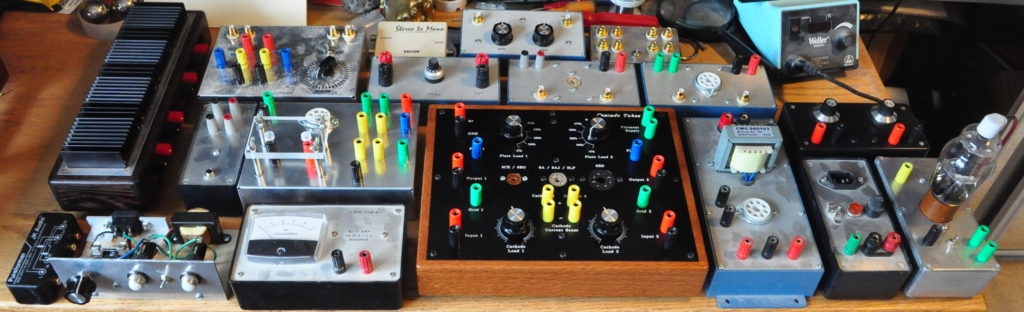
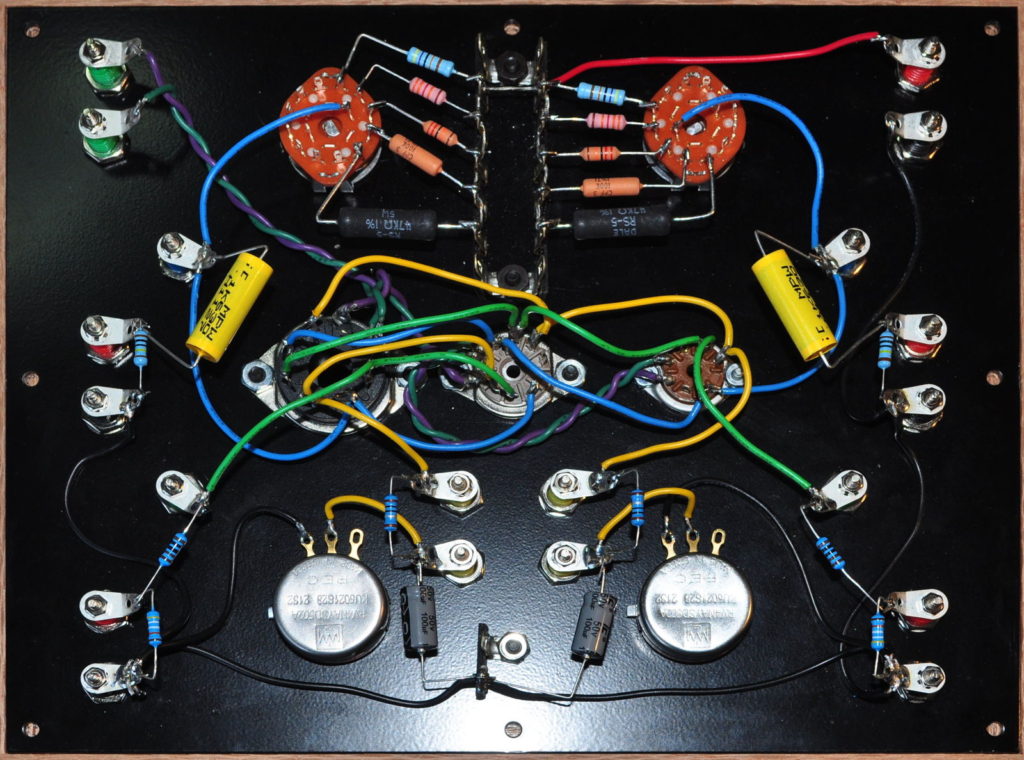
And this picture doesn’t even contain them all. As I looked at the collection of various jigs and fixtures, it struck me just how many I’ve accumulated over the years. It’s quite the eclectic mix. Some are commercially made but most are my own creations. The simplest is just a headphone jack and four banana jacks in a small box. Probably the most complex is the dual triode test jig. Here’s what that one looks like inside.
Lest anyone think I spend an inordinate amount of time building jigs, I want to say that the collection pictured above (as well as those not pictured) has taken over 40 years to acquire. Some of these are quite new. The dual triode test station front and center was just completed several weeks ago. And others are years old. The oldest in the picture above is the small current meter in the front row on the left. This was the first single purpose electronics jig I built over forty years ago. I’ve been carrying it from place to place and using it more than a few times over the intervening years.
Now some people don’t understand why I keep all this stuff lying around and cluttering up my parts closet. But my general philosophy concerning jigs and fixtures like this is simple.
Build it when you need it. Keep it forever because someday you’ll need it again.
Most of these have been used multiple times since they were first made. Each time they saved me both time and effort, allowing me to better focus on the project or task at hand. And just because I’ve built it doesn’t mean I won’t modify it for some similar purpose later on. These are tools. And like any tool they simply allow me to do things I want to do more easily and with greater precision and safety.
As always, questions and comments are welcome.