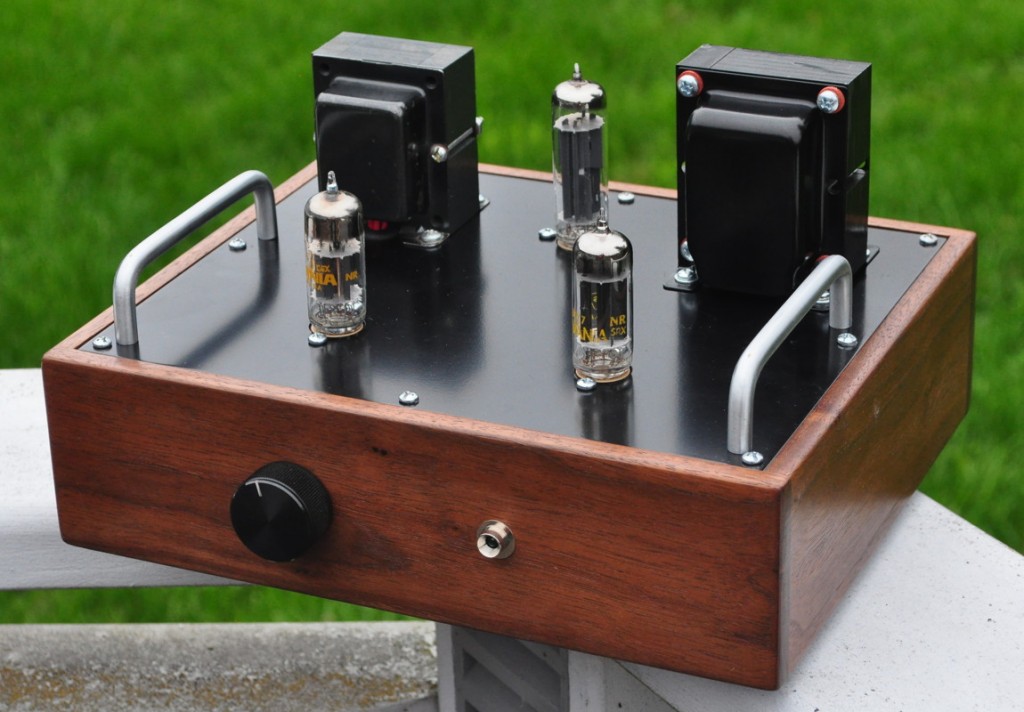
An Exercise in Reuse
This amplifier came about due to an unexpected turn of events. Those with sharp eyes will recognize that the chassis for this amp is actually from the “Recovery” headphone amplifier. This is what happened. Shortly after I finished the Recovery amp, I started work on my 6V6 Lacewood amplifier. I used the Recovery amp for a while, however when the 6V6 Lacewood amp was completed, it quickly became my default amplifier for most of my music listening. By this time I already had the “Rebuild” headphone amplifier for my desk at work and I had largely stopped listening with headphones at home. This meant that the Recovery amp was put aside.
Then recently I decided I could not simply let this unit sit unused. So I began to look for a suitable project. At first I was thinking some type of preamp until I realized that the power transformer used for the Recovery amp could be reused for a small stereo amp. It is an older Hammond 269EX with a 190-0-190 @ 65mA high voltage winding and a 6.3v @ 2.5A filament winding. As it turned out, this is exactly what was needed to build a circuit using the 6CY7 which I had prototyped a few years before using that very transformer.
The Electrical Design
This amplifier is based on another of the vertical deflection dual triodes built for televisions; the 6CY7. This particular tube has a power section with a peak plate dissipation of 5.5 watts. This should translate to a little over one watt per channel. As I said, I had prototyped this amplifier a few years before while exploring alternate tubes. So I went back and revisited the load line designs I had done at that time. Here is the load line for the power section.
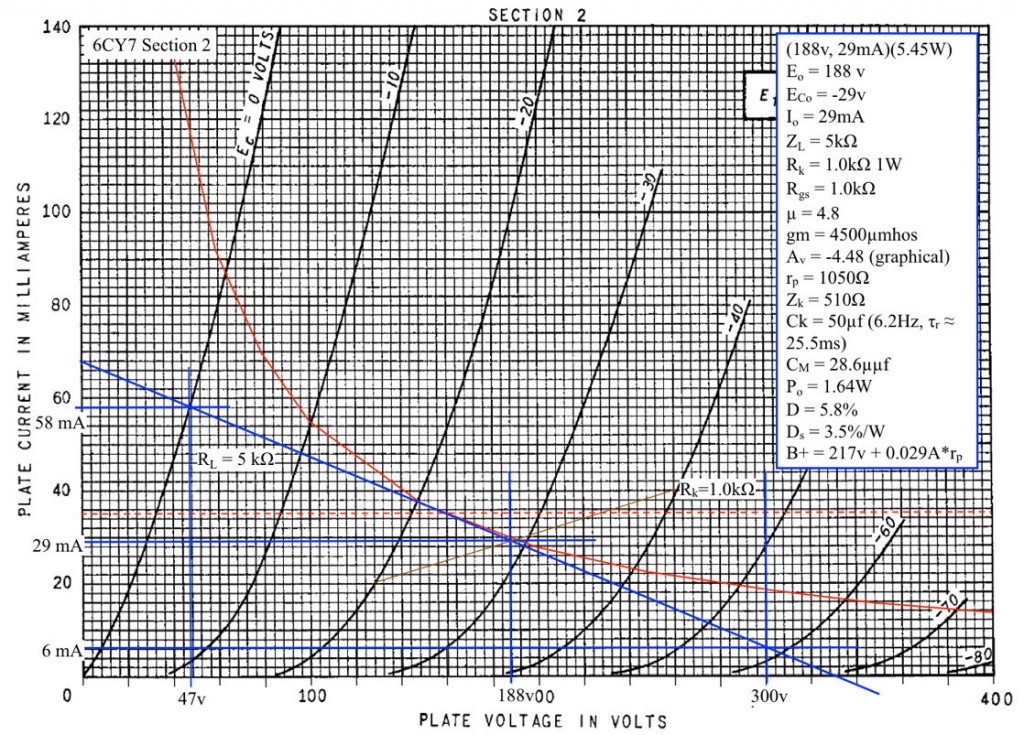
This indicates a peak power into the output transformer of about 1.6 watts. The distortion also looks well controlled. I need about 29v-peak to drive this power stage. From a line level signal, that means that the driver needs a voltage gain of at least 23dBv. Given the nature of the 6CY7 section 1 triode, this should not be a problem. The published amplification factor is 68 so we should be able to get at least 2/3rds of that. The driver stage load line is shown below.
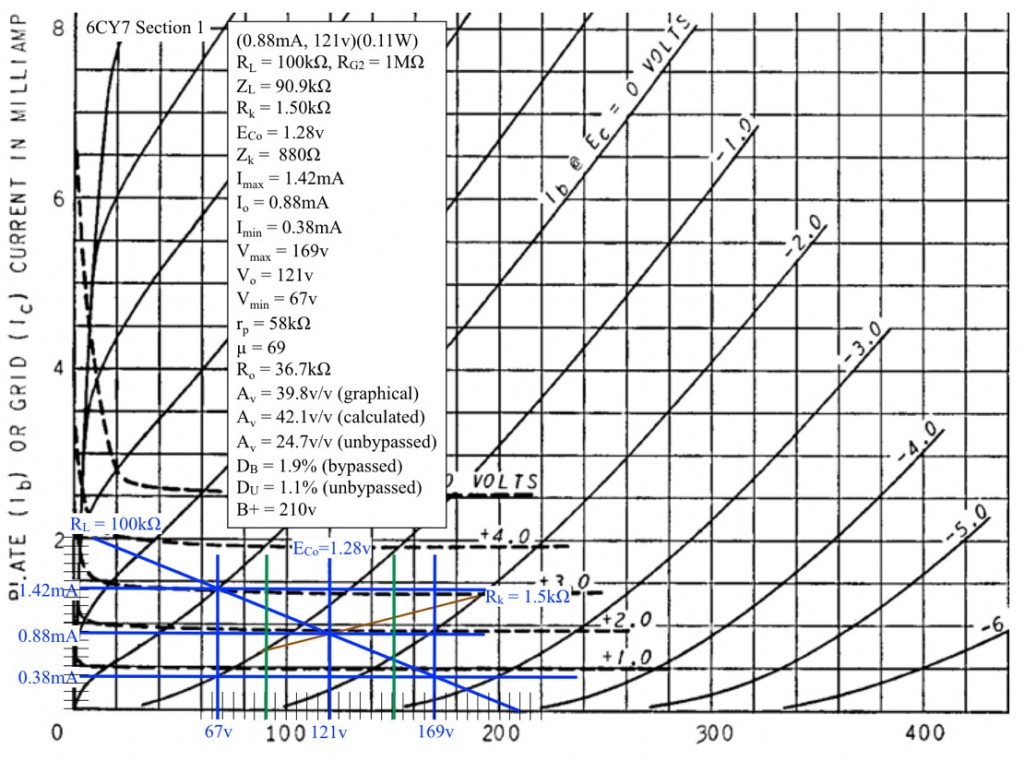
This design shows that this stage will meet both the gain and voltage swing requirements without a problem. The interstage coupling capacitor is calculated as 0.01µf. Here is the final schematic for the amplifier.
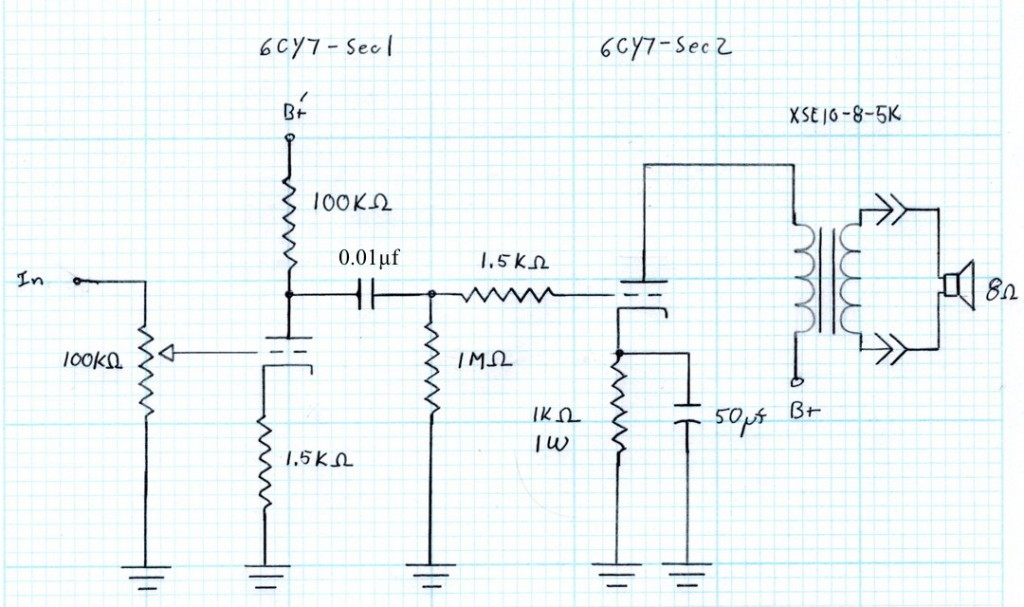
This is a very simple circuit that should be very easy to drive. With the volume control at max, it requires about 1.2v peak (or 0.85v-rms) to drive the amplifier to full power. Most small devices like iPods, phones, and portable CD players will easily drive this amplifier. Here is the power supply design for this amp.
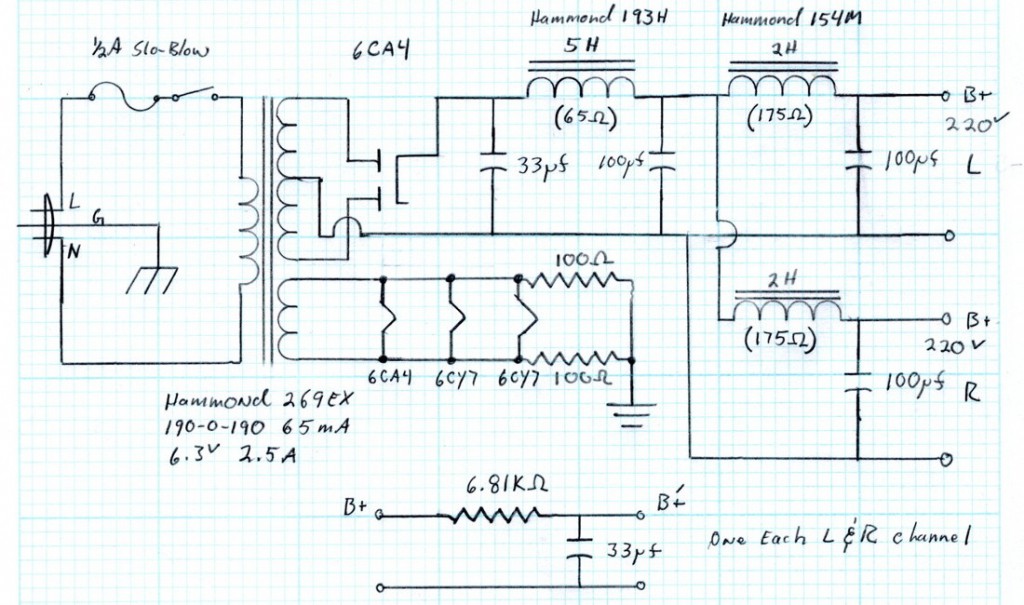
The power supply is a typical split rail design with separate filtering for left and right channels. This helps provide good channel separation and a nice wide sound stage.
The Build
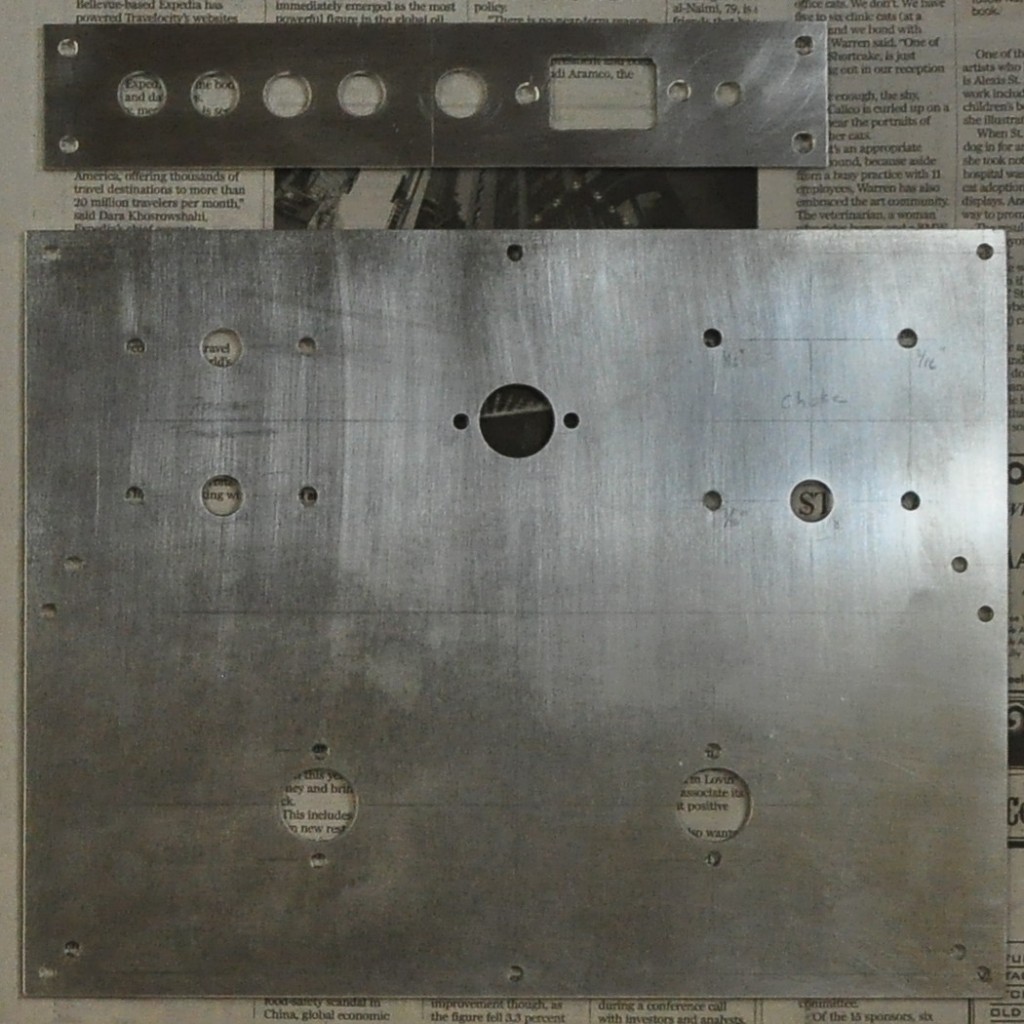
The build for this design needed to proceed along a little bit different lines as the chassis was already built. The new design needed to make use of the current wood chassis layout as this was not going to change. A new top plate was in order because of the different number of tubes, the headphone jack went away and was replaced by a power indicator, and a new rear plate was made to accommodate the speaker binding posts. I also decided that I wanted a nice inductor up top to match the power transformer, so I ordered a Hammond 193H for the primary filter choke. I would be reusing the power transformer, IEC connector, fuse and holder, power switch, tube sockets, input jacks and volume control, 2H filter chokes, and the handles on the top plate.
This level or redesign meant that I only needed two new pieces of metal. These are shown in the picture below, just before painting.
The only real challenge to this design was to decide how to mount the output transformers. I decided to use Edcor open frame XSE100-8-5K transformers and I needed to mount them both inside the chassis. This turned out t be not too difficult. After this decision was made, it was time to start wiring. I decided that I would do as much wiring as possible with the top plate removed from the chassis. This way there is plenty of room to work and seeing things is not a problem. Here is an in progress picture of the top plate wiring.
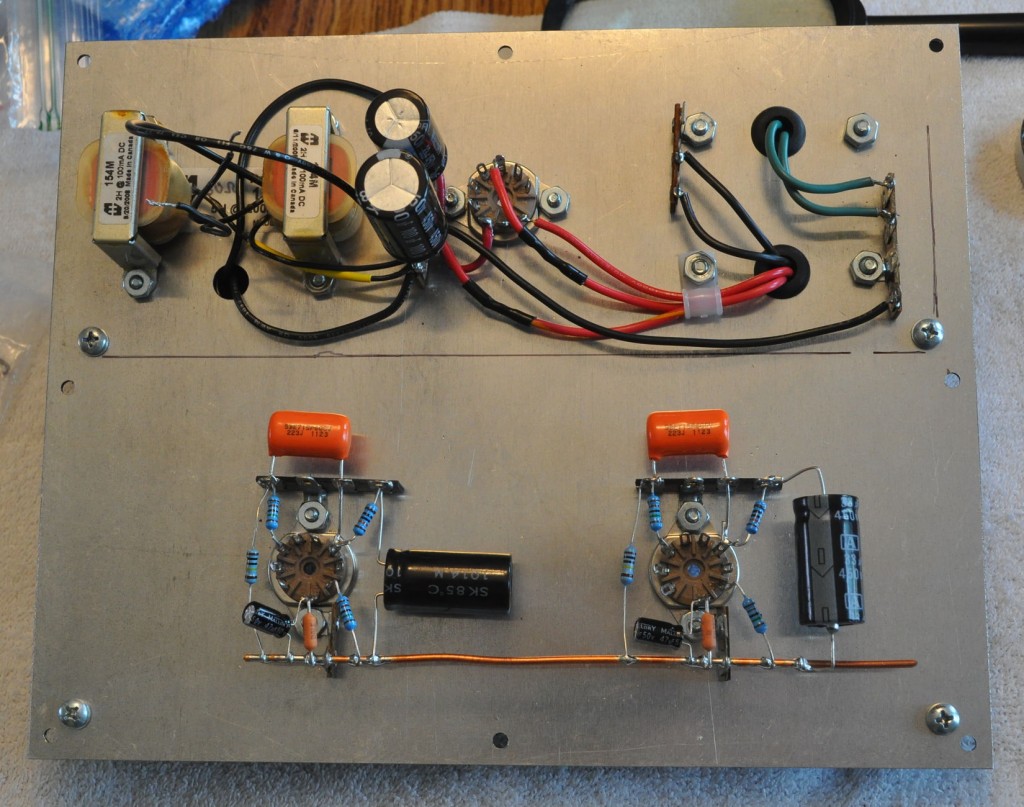
Here the individual components for each channel are mounted to the sockets and the primary portion of the power supply and filter are mostly wired. Wiring in this fashion is significantly easier than doing it with the plate installed on the chassis. Here is an inside shot of the final amp all wired up.
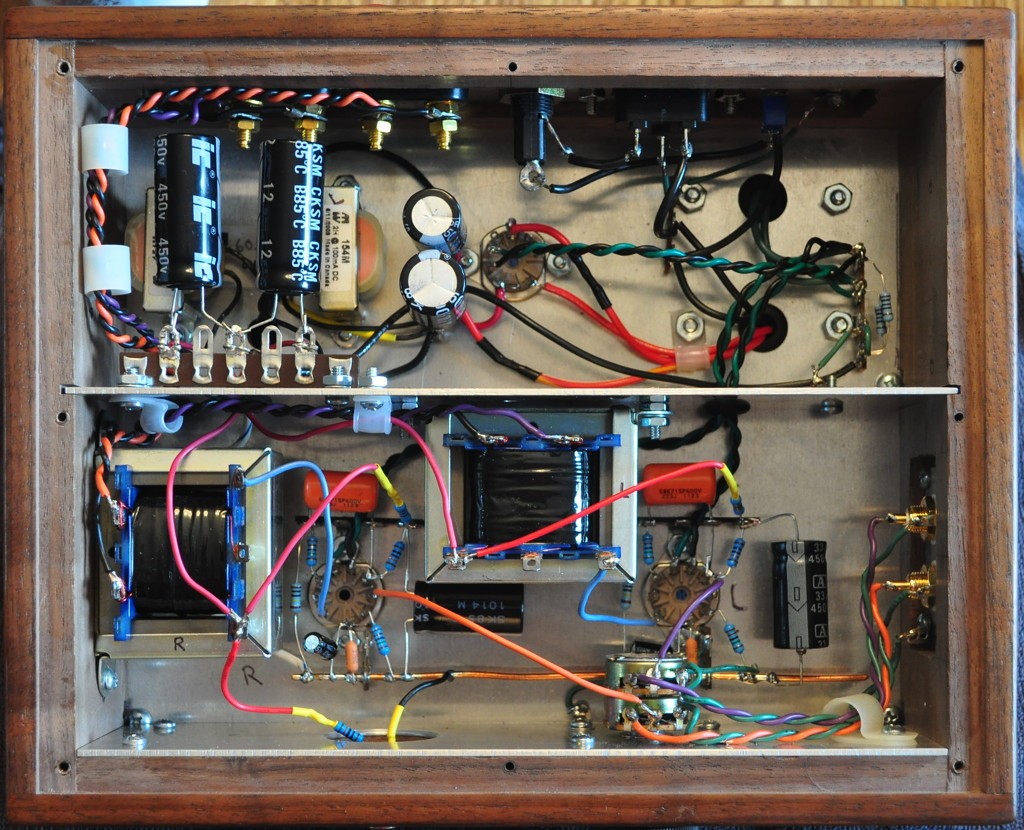
The two filter caps on the upper left are the individual 100µf capacitors for each B+ channel. They are suspended in mid air over (or under) the 2H chokes.
Testing
So this amp went through the typical test regiment I give most of my new builds. Here it is all hooked up and in progress. The signal generator is on the left, the dual channel AC voltmeter for checking response is in the middle, and the oscilloscope for checking waveforms is on the right. The unit right to the right of the amp is a dummy speaker load.
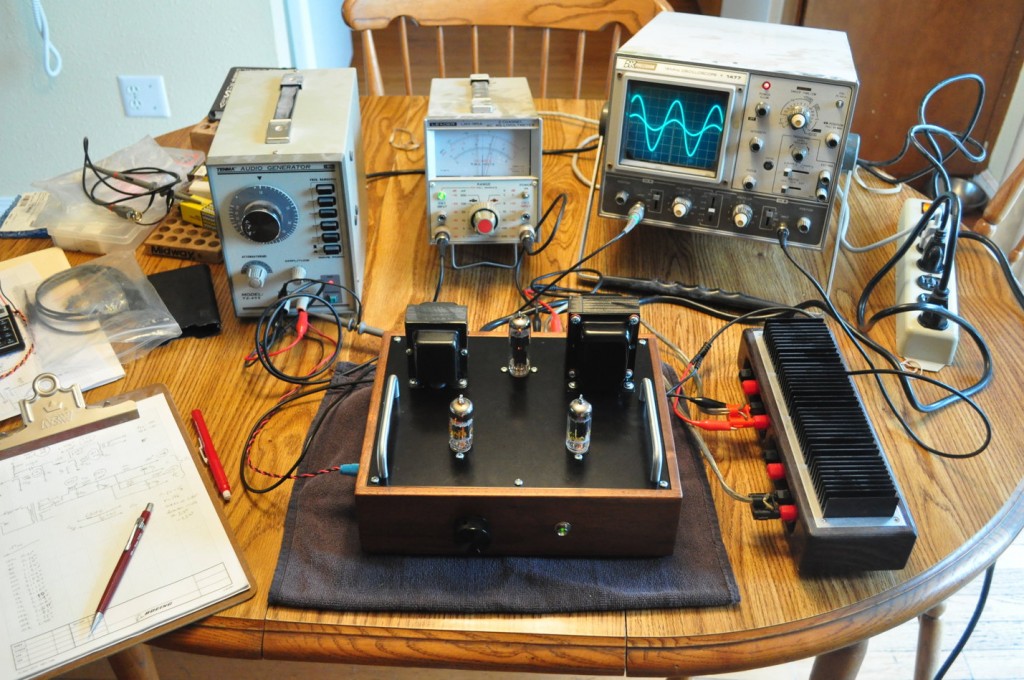
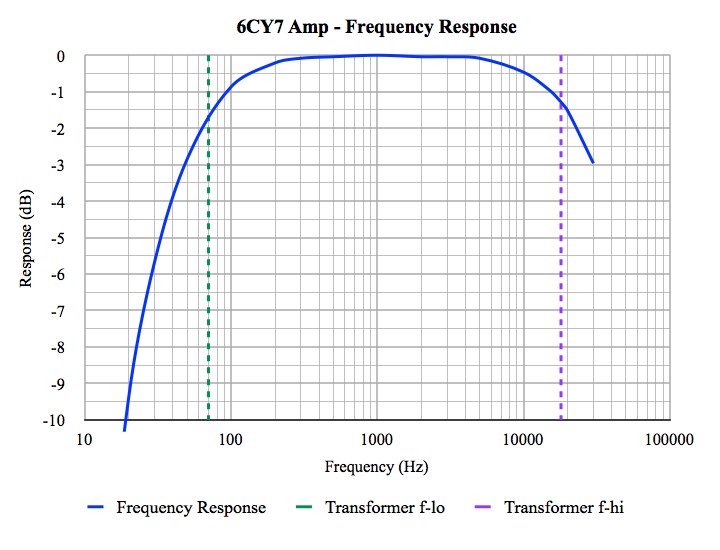
At full output the amp produces a clean 1.3 watts output per channel into 8Ω. The Edcor XSE output transformers are rated from 70Hz to 18kHz. This amplifier did a little better than this having a -3dB bandwidth from about 46Hz to about 30kHz. Here is a plot of the frequency response measured into an 8Ω load.
Impressions
I still can’t get over how good and how loud this amp sounds. It handles everything from classical, to blues, to choral music equally well. And the sound stage is awesome. I will never go back to building common power supply filters for both channels ever again. I’ve had this amp plugged into my system on and off for the last couple of weeks and I am absolutely blown away by the quality of the sound coming from this little unit. I don’t know what it is, but these little triodes are just the best sounding tubes I have ever heard.
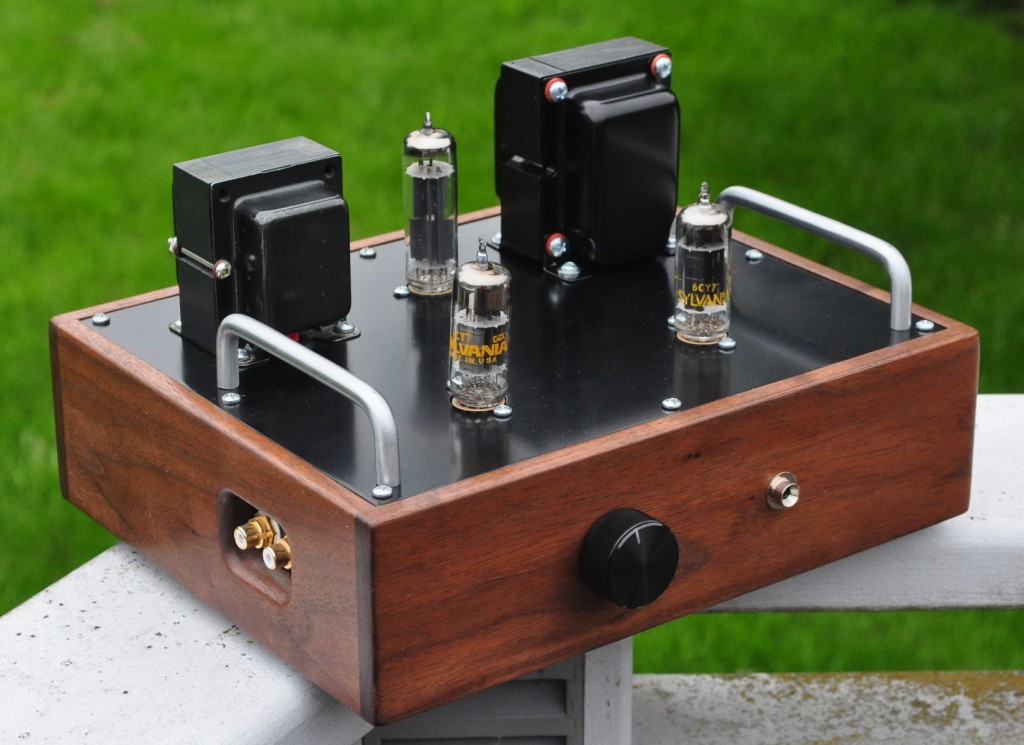
This is quickly becoming my favorite amp. I currently have a set of NOS Sylvania tubes in it, but I have also used a set of old used GE tubes which sound just as good. This is really a pretty inexpensive build. I highly recommend that anyone looking for a little iPod or computer amplifier give this one a try. You will NOT be disappointed!
As a follow up: This amp was originally designed in 2011 and whereas it has always sounded excellent, there is a new version available for building. The new design upgrades the output transformers and some circuit values to produce even better results. You can read about the new amplifier at The 6CY7 V2.0 “Zebrawood” Amp. You can build either amp, they both sound excellent, but you should read about them both.