The resistors for which I’ve been waiting to finish the amp showed up in the mail yesterday. Today I got the final resistor installed and did a full check on the amplifier.
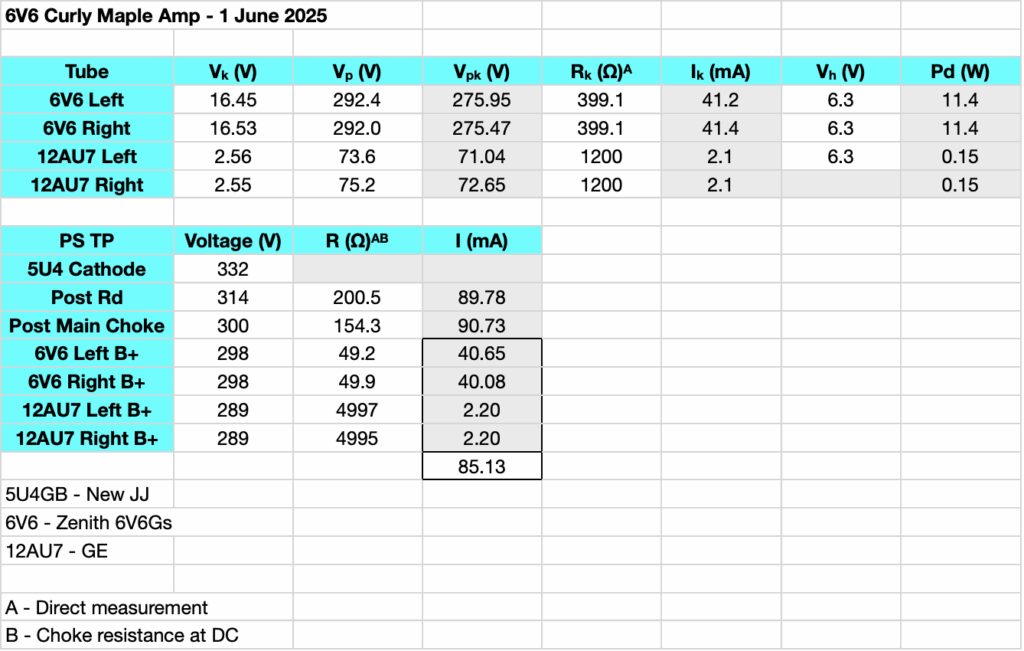
The resultant voltages throughout the amplifier were very close to their design points. The desired power stage B+ for this amplifier was 300V. Actual power stage B+ voltages came in at 298V for both channels. This is within 0.7% of target. The 12AU7 operating points were only about 5 volts low in plate voltage and the power stages were almost exactly on their designed operating point of 275 Vpk. Here is the complete voltage table from today’s initial testing.
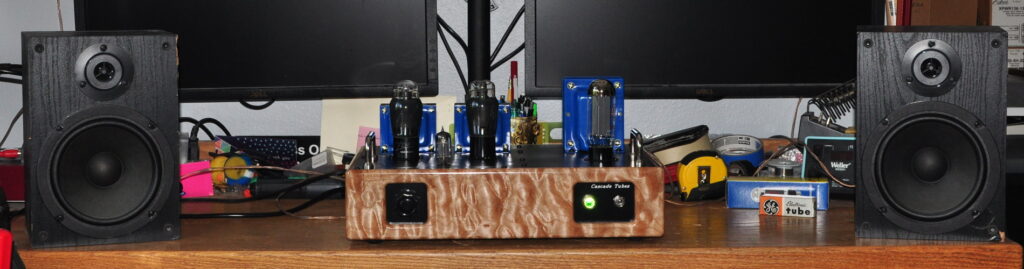
Following the initial technical testing, I righted the amplifier and spent about an hour feeding it different types of music to get a feeling for how it sounds. Here she is sitting on my work desk in my office.
First off, the amp is dead silent. With no input there is nothing to be heard even with my ear directly up against the speakers. I’m very pleased with how this build came out. Second, this amplifier has probably the best imaging of any amplifier I have ever built. It is even better than the 6L6 Spalted Alder amplifier. Recall that I said of the 6L6 Spalted Alder:
When listening to good classical scores I could easily pick out individual instruments and their details.
That amplifier has very good imaging. This amplifier is even better! Picking out instrument and vocal positions was effortless. This applies to everything from small group jazz to big classical scores. The imaging is just that good!
I also investigated that improved bottom end I was going for in this design. It didn’t disappoint. My typical bass test tracks, Not Fragile (quad mix) off the Bachman-Turner Overdrive “The Anthology” album and Cold Cold Heart off the Norah Jones “Come Away with Me” album, both came through both clean and very powerful. I also added 99 Pounds from Humble Pie’s “The Definitive Collection” album and a couple of Avi Kaplan songs, Change on the Rise and First Place I Go. These also came through with powerful and well controlled bass lines. I was also able to pick out fine details that aren’t always obvious. On this amp the detail is incredible.
I even tried out some Gregorian Chant recorded in a cathedral. These tracks are usually notoriously hard for detailing because of the natural reverberation of the recording environment. I could easily find the positions of soloists withing the choir while listening to these tracks on the new amplifier.
The amplifier provided this excellent bass and imaging without sacrificing any speed or detail. My usual detail test track, Frederick The Great : Sonata in B-Flat – Allegro for recorder played by Michala Petri, preserved all of its speed, lightness, and detail. I tried some other fast tracks on the fly as well and all of them performed flawlessly. The larger inductance of the output transformers did not adversely affect the speed or clarity of this amplifier.
I am very pleased with how this amplifier sounds. I will be spending the next several days doing some detailed testing for power, bandwidth, and distortion before I begin my overall project write up. Having the actual numbers will be nice, but I can say now that this amplifier is hands down the best sounding UL topology amplifier I have ever built. I clearly achieved all my design goals with this design.
As always, questions and comments are welcome.