So what does one do when needing to keep twelve signal paths clearly separated and easily identified in a chassis? Actually the answer is remarkably simple.
All that you have to do is pull down the multicolored wiring kit from the shelf and make up some twisted pairs.
In this case I needed to be able to easily identify both right and left channels for six separate inputs. So the first thing I did was make a decoder table and assign colors. Here’s that table.
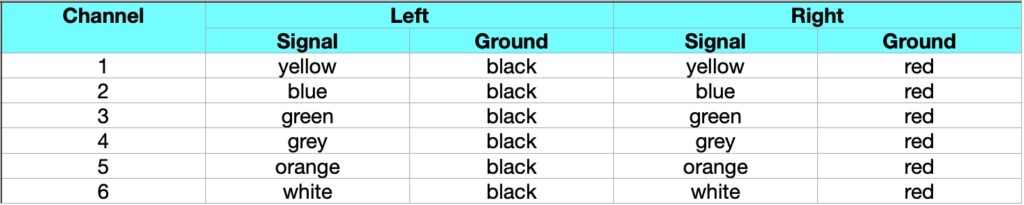
For each of the six channels, the signal line is a distinct color. And for each color, the left and right channels are identified by the color of the signal ground tie. This gives twelve combinations which may be used to uniquely identify each signal path. After that, it’s a simple matter to make up a set of twisted pairs to use for wiring the project.
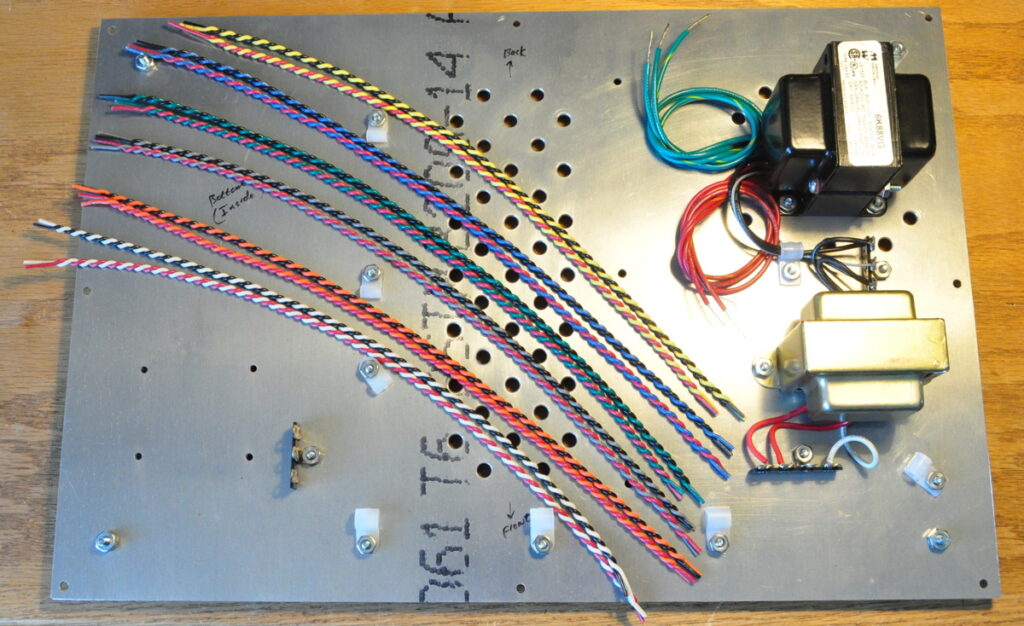
This is a good idea for several reasons. First, when soldering up the selector switch this will help me make sure that proper contact is being connected to each channel. Being able to verify this before I even install the switch will help minimize problems later. Second, this allows me to bundle the wires in the chassis before soldering up the input jacks. All I have to do is look at the table to determine which twisted pair goes to each jack. This helps keep things neat and to avoid mis-wiring inputs. Third, and probably most important, any time I want to open up the project to do any investigations or troubleshooting I can immediately identify signal paths without tracing wires and applying labels of some type. This is a huge time and frustration saver down the line.
Some people may argue that I’m really going to too much trouble just to identify some signal paths. But I don’t believe so. I once tried to help someone who had built an amp which had a horrible hum problem. When I opened it up, I discovered that he had wired the entire project with a single color of wire and paid no attention to routing whatsoever. This may be an extreme case but that problem was very difficult to solve precisely because of poor design and build decisions at the beginning. Some basic color coding rules, attention to routing and lead dress, and maybe some use of twisted pairs may well have prevent the problem in the first place. And I know it would have made the troubleshoot phase much simpler.
As always, questions and comments are welcome.